Knit, Grow, Build: How 'Grandma Hobbies' Became the Coolest Rebellion of Our Time
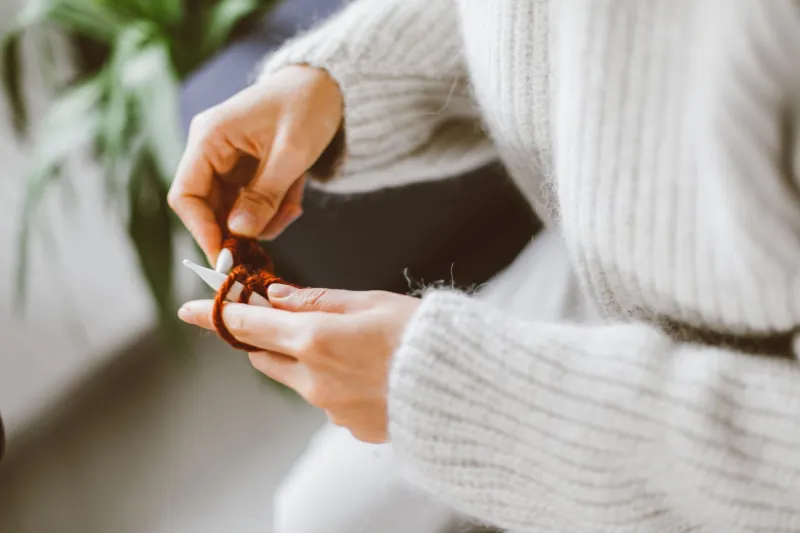
Somewhere between your third TikTok spiral of the evening and the fourteenth notification you didn't ask for, something quietly snapped for a lot of people. Not dramatically — no big announcement, no viral post about it (well, okay, maybe a few). Just a slow, creeping realization that all this consuming wasn't actually doing anything for them. And so, one by one, people started reaching for knitting needles. Seed packets. Model airplane kits. Things their grandparents did on Sunday afternoons without a hint of irony.
And now? Those same hobbies are having a serious moment.
The 'Uncool' That Became Very Cool
Let's be honest — for a long time, if you told someone at a party that you spent your weekend knitting a sweater or tending to a vegetable patch, you'd get a polite smile and a subject change. These were hobbies associated with retirement, rainy days, and a very specific kind of quietude that younger generations had been conditioned to see as, well, boring.
But something shifted. Slowly at first, then all at once.
Search interest in terms like "beginner knitting," "raised garden beds," and "model kits for adults" has surged consistently over the past few years. Subreddits dedicated to these hobbies have ballooned in membership. And if you spend any time on the craftier corners of social media — yes, the irony isn't lost — you'll find an entire ecosystem of people proudly showing off their lopsided first scarves, their overcrowded tomato plants, their meticulously painted miniature figurines.
These aren't niche communities anymore. They're movements.
It's Not About the Hobby. It's About the Feeling.
Talk to anyone who's recently gotten deep into one of these so-called boring pastimes, and they'll tell you the same thing in different words: there's something almost startlingly satisfying about making something with your hands.
Take Marcus, a 29-year-old software developer from Austin, Texas, who got into model building during a particularly brutal stretch of remote work. "Everything I was doing at my job was invisible," he says. "Like, I'd finish a sprint and there was nothing to hold. Nothing to point to. I started building model cars just to have something I could put on a shelf and say, 'I made that.' It sounds small, but it genuinely changed my mood."
Or Priya, a 26-year-old marketing coordinator in Chicago who started a container garden on her apartment balcony last spring. She laughs when she describes her first harvest — three cherry tomatoes and a single jalapeño — but there's real pride underneath it. "I literally took a photo and sent it to my mom like I'd won something. And honestly? I kind of had."
That sense of tangible accomplishment is precisely what these hobbies offer that most of modern life doesn't. In an era of abstract work, endless digital content, and metrics that never quite feel personal, the ability to hold something you made — a finished sock, a ripe zucchini, a painted miniature — hits differently.
The Anti-Performance Hobby as Status Symbol
Here's where it gets a little counterintuitive. Part of what makes these hobbies appealing is that they're not built for performance. You can't really flex a knitting circle the way you can a gym selfie. A vegetable garden doesn't photograph as cleanly as a smoothie bowl. Model building is slow, fiddly, and deeply uncinematic.
And yet — that's become the flex.
In a cultural moment where everything feels engineered for content, choosing a hobby that actively resists that is its own kind of statement. It signals patience. It signals that you're not optimizing for likes. It says, quietly but clearly, that you have an inner life that exists outside of what's shareable.
"There's a whole vibe shift happening around what people consider impressive," says Jordan, a 31-year-old teacher in Portland, Oregon, who runs a small knitting circle that's grown from four friends to nearly twenty people in under a year. "A few years ago, everyone wanted to seem busy and productive and on-brand. Now people are showing up to hang out, make stuff with their hands, and just talk. Like, actually talk. It's almost radical."
Knitting circles, in particular, have taken on a social dimension that goes well beyond yarn. They're functioning as the kind of low-stakes, screen-free community spaces that a lot of people have been quietly craving.
The Wellness Angle Nobody's Selling You
It's worth noting that the mental health benefits of these hobbies are genuinely well-documented, even if the research doesn't come in the form of a branded wellness app. Repetitive hand movements — like knitting, crocheting, or even weeding a garden — have been shown to reduce cortisol levels and activate a mild meditative state. Gardening has been linked to lower rates of depression and anxiety. Even the focused concentration required for model building can function as a form of mindfulness that's a lot cheaper than a meditation subscription.
None of this is why most people pick these hobbies up, but it's a big part of why they stick.
"I didn't start knitting for my mental health," admits Leah, a 24-year-old graduate student in Nashville. "I started because my roommate had yarn lying around and I was bored. But now I genuinely look forward to it in a way I don't look forward to much else. It's the one part of my week where my brain just... quiets down."
So What's Actually Going On Here?
If you zoom out, what you're looking at is a generation — actually, a couple of generations — quietly course-correcting. After years of being told that productivity was identity, that your personal brand was a real thing that needed tending, that every experience was content waiting to happen, a lot of people are exhausted in a way that's hard to name.
These hobbies are the antidote. Not because they're trendy (though they are, a little), and not because they look good on Instagram (though some people make them look great), but because they offer something genuinely rare right now: a reason to sit still, use your hands, and care about something small.
The boring hobby isn't boring anymore. If anything, it might be the most interesting thing happening in American leisure culture right now. And if you'll excuse the pun — it's only just getting started.
Got a hobby that people used to make fun of you for? We'd genuinely love to hear about it. Drop it in the comments.