Hey, How Are You? — And Actually Meaning It: The Quiet Return of Low-Stakes Conversation
Somewhere between the rise of "authentic connection" culture and the mainstreaming of therapy-speak, casual conversation got a bad reputation. Small talk was shallow. Pleasantries were performative. Talking about the weather was the ultimate waste of two people's time and potential. The goal, we were told, was to skip straight to the real stuff — the raw, the vulnerable, the meaningful.
That pressure turned a lot of social interaction into hard work. And people are tired.
What's happening now, quietly and without much fanfare, is a reclamation of the meaningless exchange. The stranger you chatted with in line at the coffee shop. The neighbor you waved to and actually stopped for a minute. The bartender you talked baseball with for twenty minutes while you waited for your friend. Low-stakes, purposeless, completely forgettable — and weirdly, surprisingly, wonderful.
Small talk is having a moment. And the reasons why say a lot about where we are right now.
The Deep Connection Fatigue
For the better part of a decade, the cultural message has been relentless: go deeper. Be vulnerable. Skip the surface. Countless articles, podcasts, and Instagram carousels have told us that real connection requires emotional risk, that anything less is just loneliness in disguise.
And look — there's truth in that. Genuine intimacy matters. But the overcorrection has been real. When every social interaction is supposed to be an opportunity for profound human connection, the pressure becomes suffocating. Suddenly, you're not just having dinner with a friend; you're supposed to be doing the work of authentic relating. A party isn't just a party — it's a social performance that should ideally result in meaningful bonds.
That's exhausting. And for a lot of people, it's made the idea of socializing feel more like a task than a pleasure.
Dr. Gillian Sandstrom, a social psychologist who has studied what she calls "weak ties" — the casual acquaintances and strangers we interact with briefly — has found that these low-stakes interactions contribute meaningfully to wellbeing and sense of community, often more than people expect. The barista who knows your order. The guy you always see at the gym. The woman in your building you've chatted with about her dog three times but whose name you don't know. These connections matter.
The Coffee Shop as Social Sanctuary
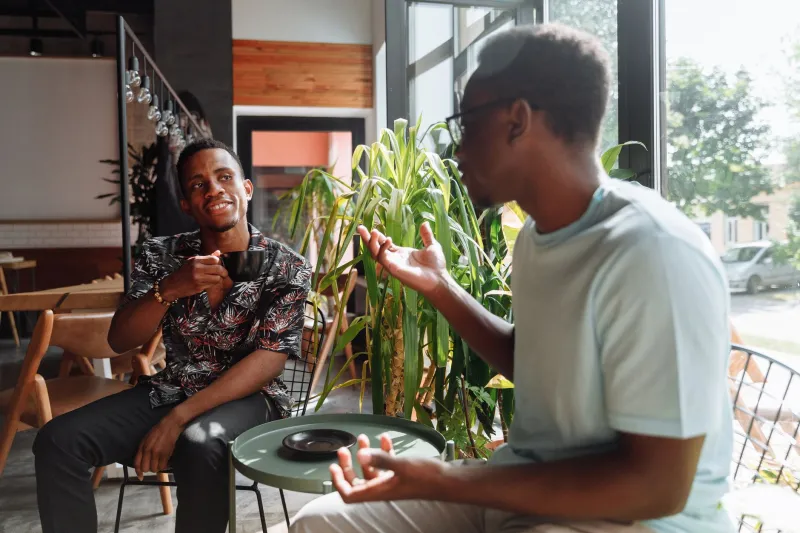
Walk into any busy coffee shop on a weekday morning and pay attention. People are talking. Not just to the people they came with — to the strangers next to them, to the staff, to whoever happens to be within conversational range. There's an ease to it that feels almost retro.
Some of this is a post-pandemic recalibration. After years of isolation, a lot of people came out the other side with a renewed appreciation for the simple fact of being around other humans. The low-bar interaction — the "can you watch my stuff for a sec?" or the "is this line for here or to-go?" — became genuinely pleasurable in a way it never quite was before.
But it's also a reaction to the relentlessness of online social life, where every interaction is either a performance or a transaction. In person, there's no algorithm deciding whether your comment is worth amplifying. There's no engagement metric. You say something, the other person responds, and then it's just... over. Clean. Complete.
That simplicity is increasingly rare, and people are seeking it out.
Bars, Chance Encounters, and the Beauty of Forgetting
Ask people about their favorite social memories and a surprising number of them involve conversations they can barely remember. The long night at a dive bar where you ended up talking to a retired teacher from Ohio about their cross-country road trip. The person you sat next to on a flight who had incredibly specific opinions about Chicago deep-dish versus New York-style pizza. The conversation that went nowhere and led to nothing and somehow made your whole week.
There's a freedom in talking to someone you'll never see again. You don't have to manage the relationship. You don't have to be consistent with who you were the last time you saw them. You can just be whoever you are in that moment, and then walk away.
Sociologist Eric Klinenberg, who has written about the importance of what he calls "social infrastructure" — the physical spaces where communities gather and connect — argues that we've systematically undervalued the role of third places (not home, not work) in maintaining social health. Coffee shops, barbershops, parks, local bars — these are where small talk lives, and where communities quietly hold themselves together.
As those spaces have come under economic pressure, and as more of our social lives have migrated online, we've lost something that's hard to quantify but easy to feel.
Talking About Nothing as an Act of Resistance
There's something almost radical about choosing purposeless conversation in an era that demands optimization. When every minute is supposed to be productive, every relationship is supposed to be intentional, and every interaction is supposed to be an opportunity for growth — just chatting about the game last night is a quiet act of defiance.
It says: I'm not here to get something from you. I'm not networking. I'm not building a personal brand. I'm just here, being a person, talking to another person, about nothing in particular.
Some people are actively seeking this out — going to local spots specifically because they're known for being conversational, choosing the bar seat over the corner table, saying yes to the block party they would have skipped three years ago.
The Case for Keeping It Light
None of this is to say that deep conversation doesn't matter, or that vulnerability is overrated. It isn't. But there's a spectrum of human connection, and we've been so focused on one end of it that we've let the other end atrophy.
Small talk is the connective tissue of community. It's how strangers become familiar, how neighborhoods develop character, how we remind each other — in the most low-pressure way possible — that we're all just people, bumbling through the same Tuesday.
So next time someone asks how you're doing, maybe don't deflect with a one-word answer. And maybe don't launch into your emotional journey either. Just — talk. About the weather. About the game. About whatever.
It's enough. It might even be exactly enough.